Notgeld Koeslin ( 1921 )
 February 7th, 2005 |
  Author: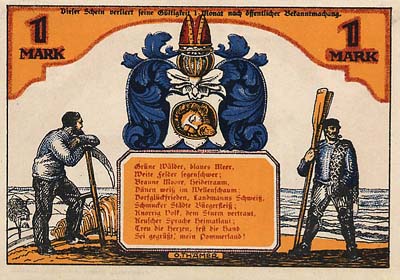
Im Zuge der Bewältigung der Kriegsfolgelasten setzte sich die Geldentwertung durch die Aufnahme neuer Staatsschulden unvermindert fort. Soziale Leistungen für Kriegsopfer und Hinterbliebene sowie die Umstellung der Kriegswirtschaft auf eine Friedensproduktion destabilisierten den Reichshaushalt in immer größerem Ausmaß. Zur hohen Staatsverschuldung kamen die aus dem Versailler Vertrag abgeleiteten Reparationsforderungen, die erstmals im April 1921 beziffert und von den Alliierten wenig später mit dem Londoner Ultimatum durchgesetzt wurden. Mehr als 132 Milliarden Goldmark wurden vom Deutschen Reich als Kriegsentschädigung in Dollar ($), Pfund (£) und Franc (FF) gefordert.
Um nicht die Verantwortung für die innenpolitisch heftig umstrittenen Reparationszahlungen übernehmen zu müssen, trat die amtierende Reichsregierung unter Konstantin Fehrenbach zurück und wurde am 10. Mai durch ein von Joseph Wirth geführtes Kabinett ersetzt, das die alliierten Forderungen so weit wie möglich erfüllen wollte, um zu demonstrieren, daß die alliierten Forderungen auch bei bestem Willen unerfüllbar seien. Die “Erfüllungspolitik” führte zu einer starken Polarisierung und gab den rechten Oppositionsparteien Auftrieb in ihrer nationalistischen Hetze gegen Politiker wie Matthias Erzberger und Walther Rathenau.
 Posted in
Holland-Amerika line
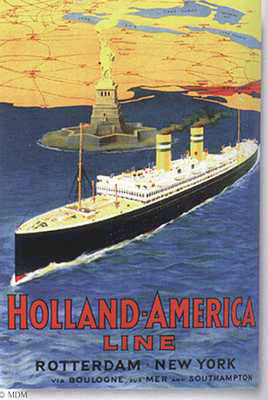
The S. S. “Rotterdam” (24,170 tons), of the Holland America Line, is one the finest,largest and most popular ships crossing the Atlantic and cost about $5,000,000 to build. She has become famous because of her exceptionally attractive features, so that many discriminating travelers choose her in preference to any other Atlantic steamer. In luxurious appointments, in extraordinary size of rooms,averaging much larger than on any of our ships on previous Cruises, as well as in her extreme steadiness, almost eliminating seasickness, she is unsurpassed.
She has 56 suites and rooms with brass bedsteads and private baths, and over 100 single rooms, together with a beautiful Palm Court, Verandah Cafe, Elevator, Social Hall, Library, 3 Smoke Rooms, a glass enclosed Promenade Deck, electrically forced ventilation of hot and cold air, etc. Most of the outside staterooms have two, and in some cases three, windows or portholes, some being fitted with a device that admits fresh air freely, even when the porthole is closed. One of her most attractive features is an immense Dining Saloon, seating nearly 500 people at small tables, where all of our passengers will take their meals, and where an orchestra of artists of high merit will play during lunch and dinner, as well as in the Social Hall in the evening.

blue mitchell quintet ( 1965 )
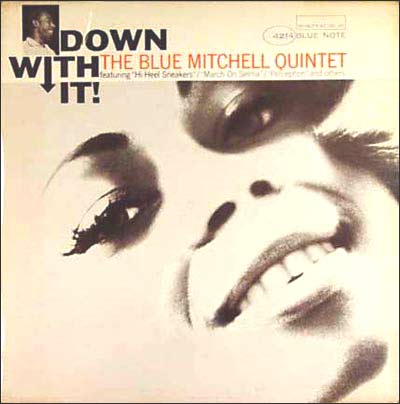
Blue Mitchell was born March 13, 1930 in Miami, Florida. He took up trumpet in high school where he acquired his nickname. After high school, he toured with R&B bands led by Paul Williams, Earl Bostic, and Chuck Willis. After returning to Miami, he was heard by Cannonball Adderly, who took him to New York to record for Riverside in 1958. Mitchell gained a reputation working with Horace Silver’s quintet from 1958 to March of 1964, where his lyrical playing and beautiful tone perfectly complemented Silver’s simplified, soulful brand of bop. When Silver disbanded in 1963, Mitchell formed his own group, employing most of his fellow musicians, with Silver’s place being taken by Chick Corea. This band continued until the end of the decade, at which time Mitchell joined the band that was backing Ray Charles. During the early 70s, Mitchell played with a number of artists in fields outside jazz, notably bluesman John Mayall and popular singers such as Tony Bennett and Lena Horne. Resident in Los Angeles from the mid-70s, Mitchell freelanced in both small and big bands, including those led by Harold Land, Louie Bellson and Bill Berry.
Bron: jazztrumpetsolos.com
alice nielsen
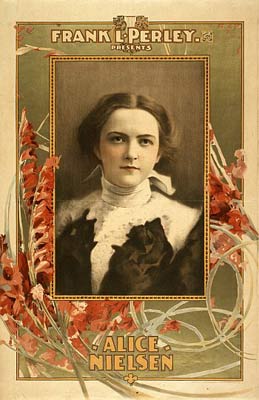
Born in Nashville, Tennessee, on June 7, probably in 1870 (some sources give 1868 or 1876), Alice Nielsen grew up in Warrensburg and then Kansas City, Missouri. She sang in a church choir and received some voice instruction from a local teacher. About 1886 she had the opportunity to sing in a touring juvenile production of The Mikado. Her marriage to Benjamin Nentwig in 1889 was short-lived. In 1892 she and three other singers formed the Chicago Church Choir Company, and, after an unsuccessful tour through Missouri, she joined the Burton Stanley traveling opera company. In Oakland, California, she appeared as Yum-Yum in the Stanley production of The Mikado in 1893. The next year, after a period at the Wigwam, a San Francisco music hall, she joined the Tivoli Opera Company, with which she made her grand operatic debut in Lucia di Lammermoor.
Bron: britannica.com