Archive for the ‘platenhoezen’ Category
Lee Morgan ( 1957 )
 January 22nd, 2005 |
  Author: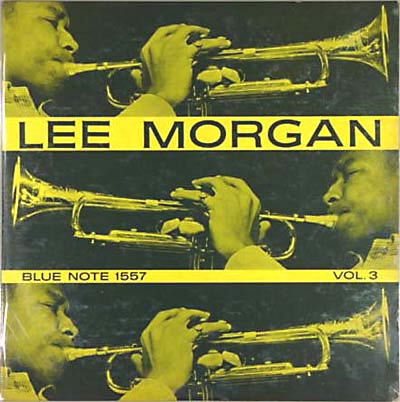
After more than a decade during which the jazz world has been inundated by teenage and even a few preteen “young lions,” it may be difficult to appreciate the sensation that Lee Morgan created in 1956. Today we tend to shrug when another 18-year-old phenomenon steps forward (usually with a recording contract from one of the major labels); but teenage trumpeters with any level of facility were less common when Lee Morgan was 18, not to mention teenage trumpeters advanced enough to not only sit in the trumpet section of Dizzy Gillespie’s big band but also to assume solo duties on Gillespie’s signature piece, A Night In Tunisia.
Bron: jazzdisco.org
 Posted in
The Real McCoy Tyner ( 1967 )
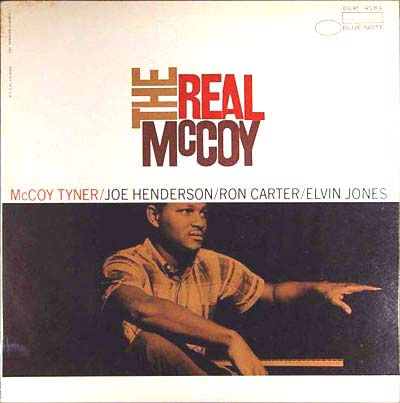
2 1/2 years after his last recording as a leader for Impulse, pianist McCoy Tyner emerged to start a period on Blue Note that would result in seven albums. Having left John Coltrane in late-1965, McCoy Tyner was entering a period of struggle although artistically his playing grew quite a bit in the late 1960’s. For this release, the pianist is teamed with tenor-saxophonist Joe Henderson, bassist Ron Carter and drummer Elvin Jones for five of his originals. Highlights of the easily recommended CD reissue include “Passion Dance,” “Four By Five” and “Blues On The Corner.”
Bron: The Real McCoy
Lou Donaldson ( 1957 )
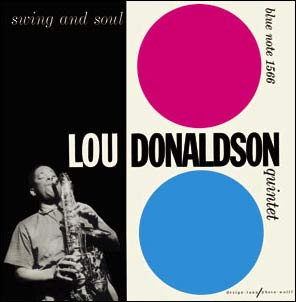
Lou Donaldson, alto saxophonist and singer. He began studying clarinet at the age of 15 and he continued to receive tuition when he joined the navy. After taking up the alto saxophone he performed in a navy band with Willie Smith, Clark Terry, and Ernie Wilkins. He first recorded with Milt Jackson and Thelonious Monk (both 1952) and as the leader of several small groups; among his sidemen were Blue Mitchell, Horace Silver, and Art Blakey (all 1952), and Clifford Brown and Philly Joe Jones (1953). In 1954 he and Brown joined Blakey’s Jazz Messengers. He continued to lead small groups, mainly in the eastern USA; he performed in Stockholm (1965) and toured and recorded in Europe (1981-82).
His early work for Blue Note (1952-1962) showed his impressive mastery of the bop style, but when in 1963 he began to record for Argo (later renamed Cadet), which specialized in funk, some of his creative spark seemed to be sacrificed to the need for commercial success. After he returned to Blue Note (1967), however, he made a series of recordings (to 1975) in which he achieved a successful blend of elements of the two styles; in the early 1980s he once again concentrated on bop. Donaldson has a dazzling technique and at his best is a strong, inventive, expressive player.
Bron: bluenote.com
Donald Byrd “Mustang!” ( 1966 )
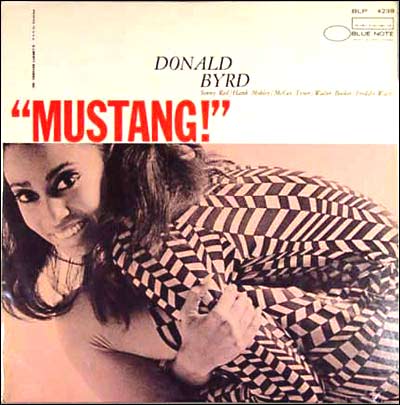
Donald Byrd, a talented hard bop trumpeter during his prime (although rarely reaching the technical heights of Lee Morgan and Freddie Hubbard), performs a varied repertoire on Mustang!. “Dixie Lee” has dated rhythms, and “Mustang” was an attempt to achieve a hit on the level of Morgan’s “The Sidewinder.” However, Byrd sounds fine on those numbers; he digs into the complex chord changes of “Fly Little Bird Fly,” is sensitive on “I Got It Bad,” swings on his “I’m So Excited by You,” and performs his memorable countermelody to “On the Trail,” which had been recorded earlier by several other musicians. Teamed with a typically impressive Blue Note crew (altoist Sonny Red, tenor saxophonist Hank Mobley, pianist McCoy Tyner, bassist Walter Booker, and drummer Freddie Waits), Byrd performs high-quality straight-ahead jazz that fits the modern mainstream of the era. Also on the CD reissue are a pair of selections (“Gingerbread Boy” and “I’m So Excited by You”) from an earlier quintet date (with tenorman Jimmy Heath, Tyner, bassist Walter Booker, and drummer Joe Chambers) that, despite being excellent, went unissued until 1997.
Bron: discography
the modern jazz quartet
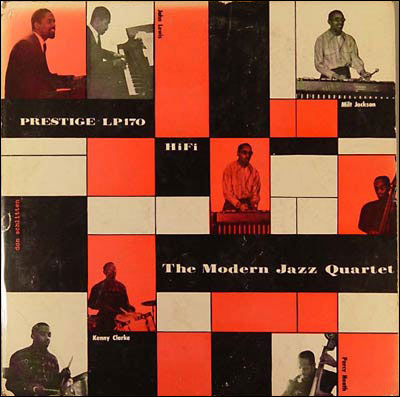
The Modern Jazz Quartet were incredibly important in the development of jazz in the 1950s, and although they officially disbanded in 1974, they’ve reformed for both concerts and recordings several times since then, making them now an “evergreen†jazz band. It was not always so.
The Modern Jazz Quartet was originally formed as the Milt Jackson Quartet (which, conveniently, had the same initials, MJQ) and consisted of Jackson on vibraphone, John Lewis on piano, Percy Heath on bass and Kenny Clarke on drums. Of these, Clarke was the veteran of the group, a drummer who had been at Minton’s after-hours club in 1939, where Charlie Parker, Dizzy Gillespie, Thelonious Monk, Charlie Christian and Clarke invented “bebop†or bop, a harmonically advanced and challenging kind of new jazz.
Bron: holeintheweb.com
maureen o’ hara ( 1958 )
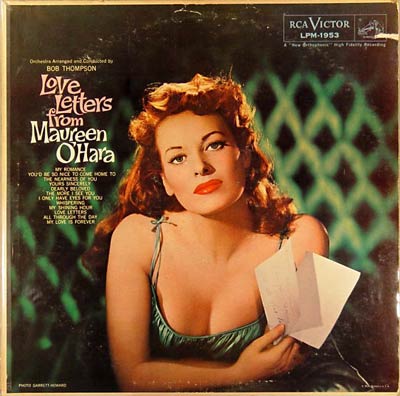
Maureen O’Hara was born Maureen Fitzsimons near Dublin, Ireland, on August 17, 1920. Another actress who was interested in show business at an early age, Maureen began to perform on the stage as well as local radio. She worked hard at her craft in order to be the best possible. By the time she was 14 years old, Maureen was winning awards in drama contests. The hard work eventually paid off. In 1938, at the age of 18, Maureen got a bit part as a secretary in the film Kicking the moon around. Later that year she appeared as Eileen O’Shea in my Irish molly.
After appearing in Jamaica Inn in 1939, Maureen packed her bags and moved to Los Angeles and the film colony of Hollywood to try her luck there. Her first film in the US was the hunchback of the Notre Dame with Charles Laughton. Maureen’s next two films, a bill of divorcement and dance, girl, dance, both in 1940, met with lukewarm reviews with the critics and fans for the film, not Maureen. She was superb in the two films.
In 1941, she played Angharad in How green was my valley. In 1947, Maureen appeared in two big hits, SINBAD Sinbad the sailor and Miracle on 34th street. The latter is now considered a Christmas classic, due to her role and that of a newcomer, Natalie Wood. 1952 saw Maureen play Mary Kate Danaher in John Ford’s hit the quiet man This film garnered Ford an Oscar for Best Director, but it was the performance by Maureen, that many said, cinched it for him. Perhaps she should have won one as well.
Maureen took a hiatus from films after 1957’s the wings of eagles, returning in 1960 in our man in Havanna. In 1961, she played Maggie McKendrick in the ever popular parent trap. Two years later she starred in the tearjerker, Spencers mountain.