Archive for the ‘platenhoezen’ Category
 February 19th, 2005 |
  Author:
 Posted in
clifford brown quintet ( 1954 )
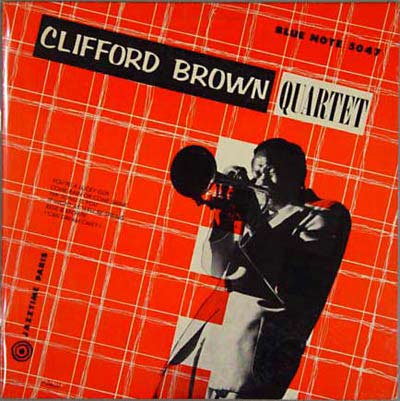
Clifford Brown was born October 30, 1930 in Wilmington, Delaware. As a young high school student Brown began playing trumpet and within a very short time was active in college and other youth bands. By his late teens he had attracted the favourable attention of leading jazzmen, including fellow trumpeters Dizzy Gillespie, Miles Davis and Fats Navarro. At the end of the 40s he was studying music at Maryland University and in 1952, following recovery from a serious road accident, he made his first records with Chris Powell and Tadd Dameron. In the autumn of 1953 he was a member of the big band Lionel Hampton took to Europe.
Bron: jazztrumpetsolos.com
lester young ( 1954 )
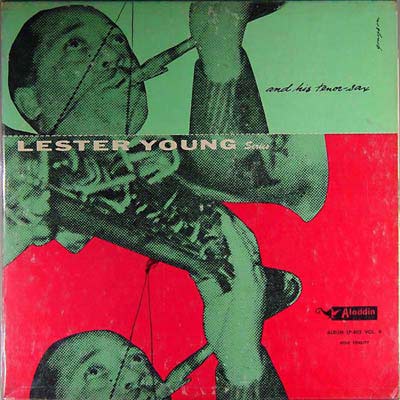
Although many of his recordings in the 1950s were excellent (showing a greater emotional depth than in his earlier days), Young was bothered by the fact that some of his white imitators were making much more money than he was. He drank huge amounts of liquor and nearly stopped eating, with predictable results. 1956’s Jazz Giants album found him in peak form as did a well documented engagement in Washington, D.C., with a quartet and a last reunion with Count Basie at the 1957 Newport Jazz Festival. But, for the 1957 telecast The Sound of Jazz, Young mostly played sitting down (although he stole the show with an emotional one-chorus blues solo played to Billie Holiday). After becoming ill in Paris in early 1959, Lester Young came home and essentially drank himself to death. Many decades after his death, Pres is still considered (along with Coleman Hawkins and John Coltrane) one of the three most important tenor saxophonists of all time.
Bron: musicmatch.com
blue mitchell quintet ( 1965 )
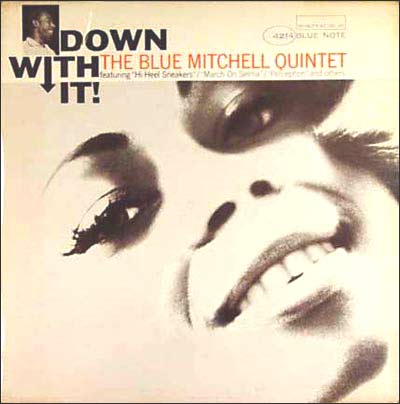
Blue Mitchell was born March 13, 1930 in Miami, Florida. He took up trumpet in high school where he acquired his nickname. After high school, he toured with R&B bands led by Paul Williams, Earl Bostic, and Chuck Willis. After returning to Miami, he was heard by Cannonball Adderly, who took him to New York to record for Riverside in 1958. Mitchell gained a reputation working with Horace Silver’s quintet from 1958 to March of 1964, where his lyrical playing and beautiful tone perfectly complemented Silver’s simplified, soulful brand of bop. When Silver disbanded in 1963, Mitchell formed his own group, employing most of his fellow musicians, with Silver’s place being taken by Chick Corea. This band continued until the end of the decade, at which time Mitchell joined the band that was backing Ray Charles. During the early 70s, Mitchell played with a number of artists in fields outside jazz, notably bluesman John Mayall and popular singers such as Tony Bennett and Lena Horne. Resident in Los Angeles from the mid-70s, Mitchell freelanced in both small and big bands, including those led by Harold Land, Louie Bellson and Bill Berry.
Bron: jazztrumpetsolos.com
sam rivers ( 1967 )
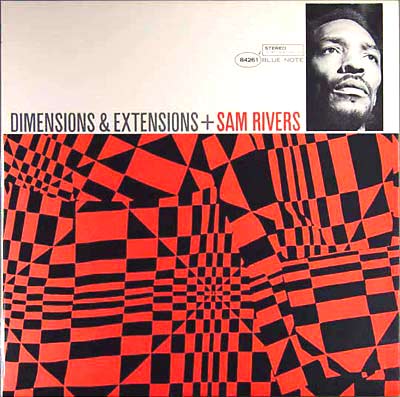
Ambitious, atonal, challenging — all are accurate descriptions of Dimensions and Extensions, Sam Rivers’ fourth album for Blue Note. Sam Rivers remains grounded in hard bop structure, working with a sextet featuring Donald Byrd (trumpet), James Spaulding (alto saxophone, flute), Julian Priester (trombone), Cecil McBee (bass), and Steve Ellington (drums), but he explodes the boundaries of the form with difficult, dissonant compositions. With his unique, mercurial tone and edgy solos, he keeps pushing the sextet in different directions. It’s intense, cerebral music, but since it has distinct themes and strong rhythms, the forays into free jazz, dissonant harmonies, and unpredictable tonal textures are actually quite accessible.
Sam Rivers simply burns on each track, whether playing tenor, soprano, or flute. Donald Byrd doesn’t display the wild imagination of Sam Rivers, yet he keeps the pace with alternately languid and biting solos. Similarly, each of the remaining musicians makes a lasting impression with his individual time in the spotlight. With music as risky at this, it’s forgivable that it occasionally meanders (especially on the slower numbers) but, overall, Dimensions and Extensions offers more proof that Sam Rivers was one of the early giants of the avant-garde.
Gerry Mulligan ( 1953 )
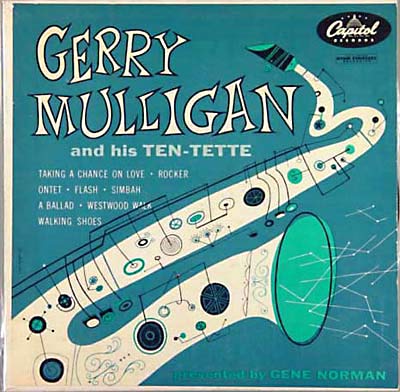
In 1952 Mulligan began a musical association that not only attracted critical acclaim but also brought him widespread popularity with audiences. His performance of “My Funny Valentine” around this time was usually stunning. This came about through the formation with Chet Baker of a quartet that was unusual for the absence of a piano. When Baker quit in 1953, Mulligan subsequently led other quartets, notably with Bob Brookmeyer in the mid-50s. He became a doyen of the California “cool jazz” movement.
Although the quartet format dominated Mulligan’s work during this part of his career he occasionally formed larger groups and early in the 60s formed his Concert Jazz Band. This band was periodically revived during the decade and beyond. He interspersed this with periods of leading groups of various sizes, working and recording with other leaders, including Dave Brubeck, in frequently rewarding partnerships with musicians such as Paul Desmond, Stan Getz, Johnny Hodges, Zoot Sims and Thelonious Monk, and writing arrangements on a freelance basis.
Bron: musicstore.mymmode.com