Archive for the ‘jaren 50’ Category
Gerry Mulligan ( 1953 )
 January 27th, 2005 |
  Author: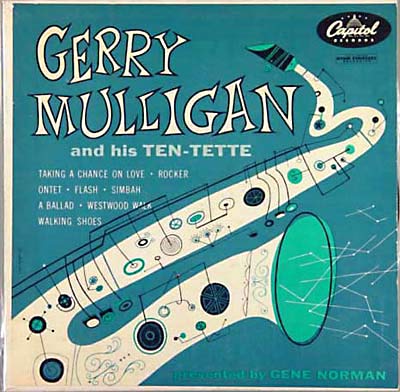
In 1952 Mulligan began a musical association that not only attracted critical acclaim but also brought him widespread popularity with audiences. His performance of “My Funny Valentine” around this time was usually stunning. This came about through the formation with Chet Baker of a quartet that was unusual for the absence of a piano. When Baker quit in 1953, Mulligan subsequently led other quartets, notably with Bob Brookmeyer in the mid-50s. He became a doyen of the California “cool jazz” movement.
Although the quartet format dominated Mulligan’s work during this part of his career he occasionally formed larger groups and early in the 60s formed his Concert Jazz Band. This band was periodically revived during the decade and beyond. He interspersed this with periods of leading groups of various sizes, working and recording with other leaders, including Dave Brubeck, in frequently rewarding partnerships with musicians such as Paul Desmond, Stan Getz, Johnny Hodges, Zoot Sims and Thelonious Monk, and writing arrangements on a freelance basis.
Bron: musicstore.mymmode.com
 Posted in
Lee Morgan ( 1957 )
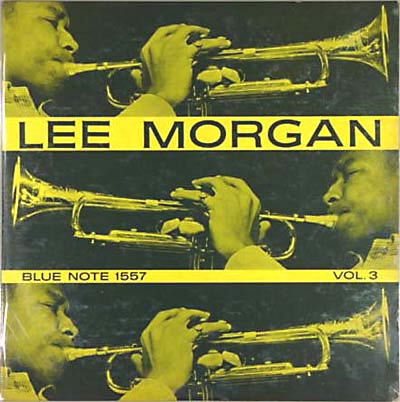
After more than a decade during which the jazz world has been inundated by teenage and even a few preteen “young lions,” it may be difficult to appreciate the sensation that Lee Morgan created in 1956. Today we tend to shrug when another 18-year-old phenomenon steps forward (usually with a recording contract from one of the major labels); but teenage trumpeters with any level of facility were less common when Lee Morgan was 18, not to mention teenage trumpeters advanced enough to not only sit in the trumpet section of Dizzy Gillespie’s big band but also to assume solo duties on Gillespie’s signature piece, A Night In Tunisia.
Bron: jazzdisco.org
sweet smell of success ( 1957 )
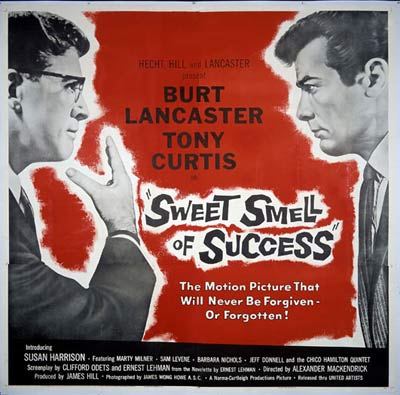
This classic film, directed by Alexander Mackendrick, is easily one of the best films of all time. A pretty bold statement, perhaps, until you’ve actually sat down and soaked in its vicious, chilled vitriol. Burt Lancaster never portrayed calculated maliciousness more convincingly, and baby-faced Tony Curtis literally drips with self-serving viciousness. It is, as Curtis’s Sidney Falco proclaims, “a cookie filled with arsenic.”
Bron: beatnikpad.com
Lou Donaldson ( 1957 )
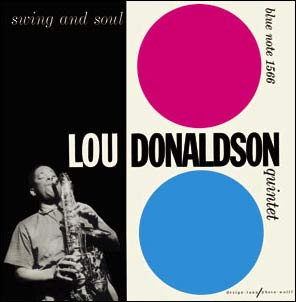
Lou Donaldson, alto saxophonist and singer. He began studying clarinet at the age of 15 and he continued to receive tuition when he joined the navy. After taking up the alto saxophone he performed in a navy band with Willie Smith, Clark Terry, and Ernie Wilkins. He first recorded with Milt Jackson and Thelonious Monk (both 1952) and as the leader of several small groups; among his sidemen were Blue Mitchell, Horace Silver, and Art Blakey (all 1952), and Clifford Brown and Philly Joe Jones (1953). In 1954 he and Brown joined Blakey’s Jazz Messengers. He continued to lead small groups, mainly in the eastern USA; he performed in Stockholm (1965) and toured and recorded in Europe (1981-82).
His early work for Blue Note (1952-1962) showed his impressive mastery of the bop style, but when in 1963 he began to record for Argo (later renamed Cadet), which specialized in funk, some of his creative spark seemed to be sacrificed to the need for commercial success. After he returned to Blue Note (1967), however, he made a series of recordings (to 1975) in which he achieved a successful blend of elements of the two styles; in the early 1980s he once again concentrated on bop. Donaldson has a dazzling technique and at his best is a strong, inventive, expressive player.
Bron: bluenote.com
the modern jazz quartet
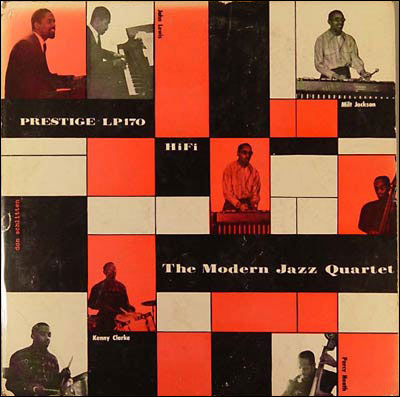
The Modern Jazz Quartet were incredibly important in the development of jazz in the 1950s, and although they officially disbanded in 1974, they’ve reformed for both concerts and recordings several times since then, making them now an “evergreen†jazz band. It was not always so.
The Modern Jazz Quartet was originally formed as the Milt Jackson Quartet (which, conveniently, had the same initials, MJQ) and consisted of Jackson on vibraphone, John Lewis on piano, Percy Heath on bass and Kenny Clarke on drums. Of these, Clarke was the veteran of the group, a drummer who had been at Minton’s after-hours club in 1939, where Charlie Parker, Dizzy Gillespie, Thelonious Monk, Charlie Christian and Clarke invented “bebop†or bop, a harmonically advanced and challenging kind of new jazz.
Bron: holeintheweb.com